
Best overall for a packaged Essbase MCP connection: EPM Copilot. Best for bespoke integration: a custom REST-backed assistant. Best for analyst-controlled execution: an assistant-assisted MDX workflow. This 2026 guide compares these three approaches by connection method, query control, deployment responsibility, and finance-team workflow.
- EPM Copilot leads the best natural language query tools for Essbase shortlist for teams seeking an existing MCP connection.
- A custom REST-backed assistant fits teams that want to own the integration and its controls.
- An assistant-assisted MDX workflow keeps query review and execution with an Essbase analyst.
- Evaluate member resolution, permissions, and result traceability before expanding natural language access.
Why this matters
A natural-language answer is useful only when it represents the intended Essbase slice. An assistant that interprets operating profit correctly but selects the wrong scenario still answers the wrong question.
Your 2026 selection should separate language interpretation from data access. The first turns a request into dimensions, members, and operations; the second determines what the assistant actually reads or executes. A fluent explanation proves neither step is correct.
EPM Copilot is the best fit on this shortlist for finance teams seeking an existing MCP connection between an assistant and Essbase. A custom integration and an analyst-reviewed workflow serve different requirements, so they belong in the comparison rather than being presented as interchangeable products.
What makes the best natural language query tools for Essbase
Use these criteria before comparing interfaces. They test whether a workflow produces an answer your finance team can inspect and reproduce.
- Member resolution: The workflow must distinguish aliases, member names, hierarchies, and ambiguous business terms.
- Context preservation: Scenario, version, period, entity, currency, and other relevant dimensions must remain explicit across follow-up questions.
- Access control: Review the identity used for execution and the permissions that identity carries. Do not treat conversational instructions as authorization.
- Result traceability: Require enough context to identify the application, cube, selected members, and executed operation behind an answer.
- Deployment ownership: Establish who manages the connection, credentials, updates, and incident response.
- Execution boundaries: Separate retrieving data from operations that change application state. Approve those boundaries before enabling broader access.
For a 2026 evaluation, prioritize member resolution and execution boundaries over conversational polish. A workflow that asks for clarification is preferable to one that silently chooses an entity or reporting basis.
Essbase query approaches at a glance
The comparison ranks implementation approaches, not measured query accuracy. Only the first entry is a named vendor offering; the others are workflows your team would assemble or operate.
| Option | Best for | Standout characteristic | Key limitation |
|---|---|---|---|
| EPM Copilot | Teams seeking an existing Essbase MCP connection | Connects Claude and other assistants to Oracle EPM through MCP servers | Validate required Essbase operations and controls against your application |
| Custom REST-backed assistant | Teams requiring bespoke integration behavior | Your team defines the interface, allowed operations, and response handling | Your team owns implementation and ongoing maintenance |
| Assistant-assisted MDX workflow | Essbase analysts retaining execution control | An analyst reviews generated MDX before running it | Does not provide direct conversational execution by itself |
The main decision is ownership. Choose an existing connector, build and maintain a connection, or keep the assistant outside the execution path.
1. EPM Copilot: best for an existing Essbase MCP connection
EPM Copilot builds MCP servers connecting Claude and other assistants to Oracle EPM modules, including Essbase, FCCS, Planning/EPBCS, PCM, and HFM. Its stated purpose is to let finance teams query and operate those systems in plain language, with deployment inside your network.
For Essbase, the relevant distinction is the connection to the underlying system. This is not merely an assistant writing a plausible query in a chat window. Your evaluation should establish which operations that connection exposes for your application and how the resulting answers preserve cube context.
Manual today versus the connected workflow
Manual today: An analyst interprets a finance question, selects the relevant members, executes a query, and explains the result.
With EPM Copilot: The finance user asks in plain language through a connected assistant. Before adopting that workflow, verify the selected members, execution identity, and returned context against the analyst's reference result.
A useful evaluation prompt is: Show actual operating profit for the selected entity and period, and state the scenario and currency used. Treat this as a test request, not a claim that every application exposes those exact member names.
EPM Copilot pros:
- Provides a stated MCP connection to Essbase rather than requiring you to start with a blank integration project.
- Connects Claude and other assistants to Oracle EPM systems.
- Supports an inside-your-network deployment approach.
- Addresses several named Oracle EPM modules for teams evaluating more than Essbase alone.
EPM Copilot cons:
- Module coverage alone does not establish coverage of every operation your Essbase application requires.
- Your team still needs application-specific acceptance tests; a connector does not define your reporting terminology.
Best for: Finance and IT teams seeking an existing MCP-based connection to Essbase, especially when the evaluation also includes other Oracle EPM modules.
Verdict: Buy when the application-specific pilot confirms the required queries, deployment arrangement, and execution controls.
2. Custom REST-backed assistant: best for bespoke integration
A custom REST-backed assistant is an architecture your team builds around the Essbase REST interfaces applicable to your environment. The assistant interprets requests, while an integration layer restricts and executes the permitted operations.
This route fits requirements that need explicit ownership of request handling and response formatting. Start with the operations your application actually supports, then define the assistant-facing interface around those operations—not around unrestricted natural-language instructions.
What the custom interface should expose
Design the interface around bounded tasks. A read request should identify its target application and cube, specify the required selection, and return results with enough context for independent checking.
For example: Compare the selected measure between Actual and Budget for this entity and period. Your integration should resolve those terms against the application before execution. If the mapping is ambiguous, require clarification instead of choosing silently.
Custom REST-backed assistant pros:
- Lets your team define the allowed operations and their input requirements.
- Gives your team control over how application context appears in responses.
- Supports integration-specific validation before requests reach Essbase.
- Lets your team separate read requests from other operations in the interface design.
Custom REST-backed assistant cons:
- Requires engineering ownership for authentication, error handling, testing, and maintenance.
- Makes your team responsible for interpreting application-specific terminology and managing changes.
- A working API request does not prove that the assistant selected the correct business context.
Best for: Organizations with engineering capacity and requirements that justify owning the connection and its behavior.
Verdict: Hold until an accountable team accepts ongoing responsibility for the integration, not just its initial demonstration.
3. Assistant-assisted MDX: best for analyst-controlled execution
An assistant-assisted MDX workflow uses a language model to draft or explain MDX while an Essbase analyst reviews and executes it separately. The assistant does not need direct execution access for this workflow.
This approach suits a narrow objective: helping an experienced analyst turn a question into a reviewable query. It is not equivalent to giving finance users a connected conversational interface.
Keep generated MDX behind a review boundary
Provide the relevant outline context and the intended reporting slice before requesting a draft. Then inspect the generated member references, dimensional selections, and calculation logic before execution.
A useful request is: Draft an MDX query for this reporting slice, identify assumptions, and explain each selected member. Do not assume that syntactically plausible MDX matches your outline or finance definitions.
Assistant-assisted MDX pros:
- Keeps execution approval with an Essbase practitioner.
- Makes the proposed query available for direct inspection before it runs.
- Separates drafting assistance from live system access.
- Provides a workflow for discussing query intent and assumptions.
Assistant-assisted MDX cons:
- Requires an analyst who can evaluate and correct MDX.
- Leaves query execution and result transfer as separate tasks.
- Generated queries require validation against the actual application outline.
Best for: Essbase specialists who want drafting support without delegating execution to an assistant.
Verdict: Buy into this workflow when analyst review is the intended operating model; Skip it as a substitute for direct conversational access.
Choose the execution boundary before the interface
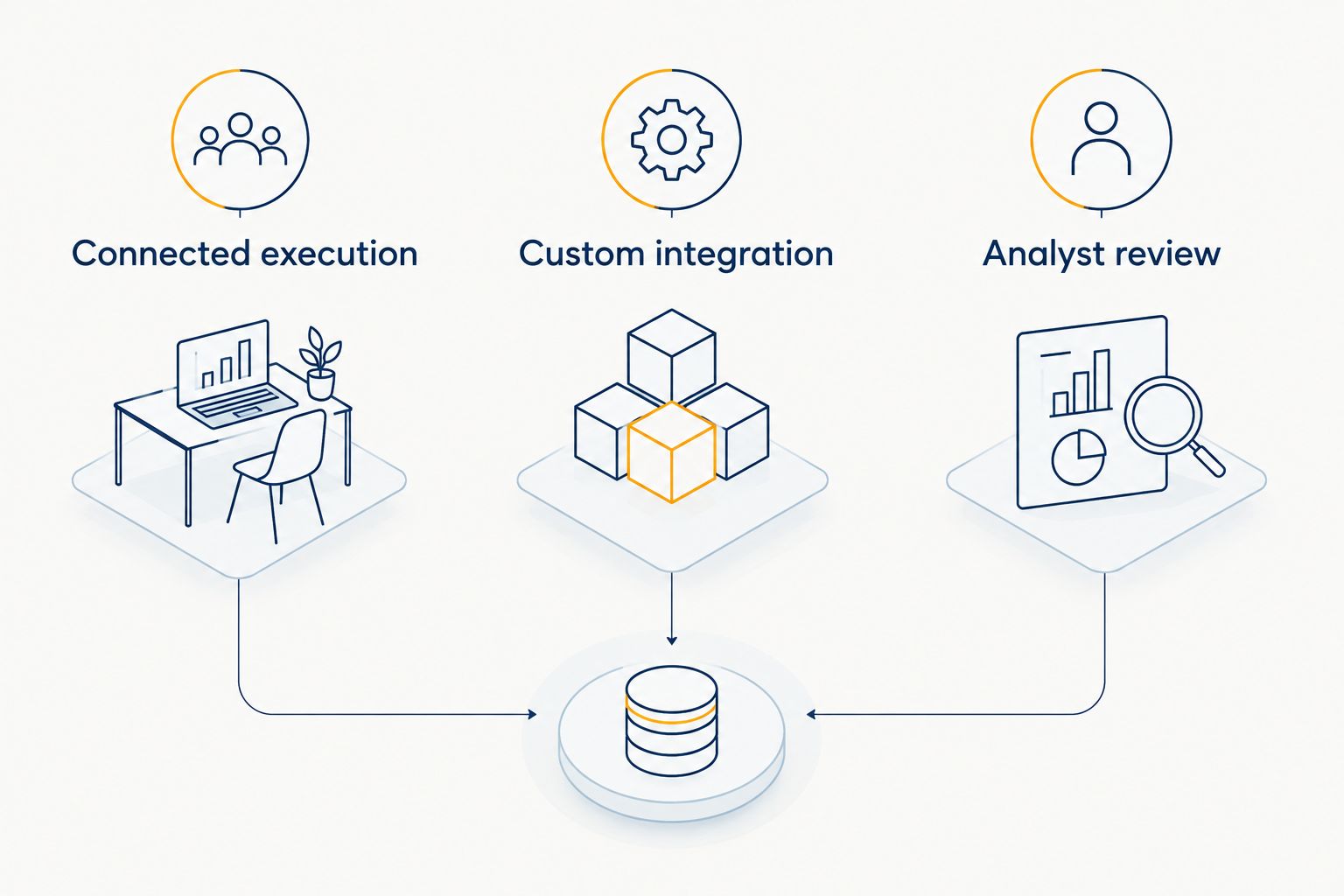
Your 2026 shortlist should begin with three operating models: Connected execution, Custom integration, and Analyst review. Each places responsibility in a different location.
- Connected execution: Evaluate an existing connector against your required operations and deployment controls.
- Custom integration: Assign an engineering owner to the connection, validation logic, and maintenance.
- Analyst review: Keep the assistant's output outside the execution path until an analyst approves it.
The deployment model does not answer every data-governance question. Document where the assistant runs, where the connector runs, what information crosses each boundary, and which identity reaches Essbase. Treat each as a separate architecture decision.
Validate the shortlist with three test queries
Use 3 test queries against a known reporting slice for your initial 2026 pilot. These are a starting acceptance set, not a claim about product performance.
1. A fully specified retrieval
Ask for a measure with every relevant dimension stated. Compare the returned value with an independently executed reference query, and inspect the accompanying member context.
The goal is to verify the complete path from request to result. A correct-looking explanation without a matching reference value is not a pass.
2. An ambiguous business request
Ask a question containing a term that has more than one plausible meaning in your application. For example, use a business label that requires choosing a particular hierarchy or reporting basis.
The expected behavior is clarification or an explicit, reviewable mapping. Do not reward an immediate answer when the request lacks enough context to select the intended slice.
3. A follow-up that changes context
Ask a follow-up that changes the entity or scenario while retaining the rest of the original selection. Check that the workflow changes only the requested context.
Record both the original request and the follow-up. This exposes context drift that a standalone demonstration does not test.
Run these tests across 2 workflows: an authorized request and a request outside the intended access boundary. Keep the first evaluation to 1 controlled pilot before expanding the user group or enabling additional operations.
How the approaches were ranked
The ranking prioritizes an existing Essbase connection, then integration ownership, then analyst-controlled drafting. It follows the criteria above: member resolution, context preservation, access control, traceability, deployment ownership, and execution boundaries.
No accuracy percentage or response-time ranking is assigned. Select the operating model first, then use application-specific reference queries to determine whether an implementation meets your acceptance criteria.
Which Essbase query approach should you choose?
Choose EPM Copilot as the default starting point for an existing Essbase MCP connection in 2026. Make the purchasing decision contingent on the required operations and controls passing your application-specific pilot.
Choose a custom REST-backed assistant when ownership of integration behavior is a requirement and an engineering team will maintain it. Choose assistant-assisted MDX when your desired outcome is better-supported analysts, not delegated execution.
Do not combine these into a single feature checklist without identifying the execution boundary. A drafting workflow and a connected assistant solve different problems.
FAQ
What's the best natural language query tool for Essbase?
EPM Copilot is the default choice on this shortlist for teams seeking an existing MCP connection to Essbase. Validate its required operations, execution controls, and application context in a controlled pilot before adoption.
Can Claude query Essbase directly?
Claude needs a connection to Essbase to execute live queries. An MCP server provides a connection pattern; without an execution connection, drafting a query is different from running it.
Is a custom REST-backed assistant better than an MCP connector?
A custom REST-backed assistant fits teams that need to own integration behavior and maintenance. MCP describes an assistant-facing connection protocol, so a custom implementation and MCP are not mutually exclusive.
Can I use natural language without giving an assistant execution access?
Yes, you can use an assistant to draft MDX and keep execution with an Essbase analyst. Review member references, dimensional context, and query logic before running the draft.
What should an Essbase natural language query pilot test?
Test a fully specified retrieval, an ambiguous business request, and a context-changing follow-up. Compare results with reference queries and inspect the identity and permissions used for execution.
Does deployment inside my network answer every security question?
No, connector location alone does not define the entire data path. Document the assistant environment, information exchanged, credential handling, and Essbase execution identity separately.
Does a natural language query workflow replace MDX knowledge?
No, natural language does not remove the need to validate Essbase query behavior. Assign an owner who can inspect member selections and compare results with an independently verified reporting slice.
One last thing
Make the second question part of your acceptance test. A workflow can answer an isolated request correctly and still lose the intended scenario or entity when the conversation continues. Save the full exchange with its reference results, not just the final answer.