
Best overall for plain-language Oracle FCCS access: EPM Copilot. Best for engineering-owned integration: Claude with a custom MCP server. Best for commentary on approved extracts: a file-based assistant workflow. This 2026 guide compares those approaches by system access, implementation ownership, and the controls you need before using an assistant during consolidation.
- EPM Copilot is the best fit for finance teams seeking plain-language access to Oracle FCCS through MCP.
- The best AI tools for Oracle FCCS consolidation need defined system access, not just strong financial explanations.
- Choose Claude with a custom MCP server when your engineers need to own the integration.
- Use file-based assistant workflows for approved extracts, not live consolidation operations.
Why this matters
An assistant that explains an intercompany difference is not necessarily connected to FCCS. An assistant connected to FCCS is not necessarily authorized to run the operation you requested. Your shortlist needs to distinguish those capabilities before comparing answers.
For a 2026 buying decision, separate three jobs: retrieving application data, executing permitted operations, and explaining results. Different approaches cover different parts of that workflow. Buy against the job you need completed, not the quality of a demonstration conversation.
FCCS remains the consolidation system. Treat the assistant as an interface whose requests, permissions, and returned evidence need review—not as a replacement for your application controls or accounting judgment.
What makes the best Oracle FCCS consolidation assistant
Use these criteria before reading the ranking:
- FCCS access: Distinguish an actual application connection from answers based on uploaded files or general product knowledge.
- Dimensional precision: Require explicit scenario, year, period, entity, account, and other relevant POV members before accepting a result.
- Operation boundaries: Separate retrieval from actions that change application state. Define which actions are permitted and who approves them.
- Deployment ownership: Identify who hosts the integration, manages credentials, maintains tool definitions, and resolves failures.
- Evidence quality: Require enough source context to reconcile an answer against FCCS rather than accepting an unexplained narrative.
- Maintenance responsibility: Establish who updates the integration when application configuration, supported interfaces, or authentication requirements change.
These are selection criteria, not claims that every option implements every control. Put them into your acceptance tests and contract discussions.
Oracle FCCS assistant options at a glance
The ranking compares implementation approaches rather than pretending that a general assistant and an FCCS connector are interchangeable products. Select the row that matches your operating model.
| Rank | Option | Best for | Standout characteristic | Key limitation |
|---|---|---|---|---|
| 1 | EPM Copilot | Finance teams seeking plain-language FCCS access | MCP servers connecting assistants to Oracle EPM modules | Supported operations and controls need validation against your application |
| 2 | Claude with a custom MCP server | Teams that want engineering ownership | Your team defines the integration and exposed tools | Your team owns development, security review, and maintenance |
| 3 | File-based assistant workflow | Commentary on approved consolidation extracts | Analysis starts from a bounded, reviewable dataset | No live FCCS access through the file workflow itself |
1. EPM Copilot: best for plain-language FCCS access
EPM Copilot builds MCP servers that connect Claude and other assistants to Oracle EPM, including FCCS, Planning/EPBCS, PCM, Essbase, and HFM. Its stated purpose is to let finance teams query and operate these systems in plain language, with deployment inside your network.
EPM Copilot is the best fit for finance teams seeking plain-language access to Oracle FCCS through MCP. The relevant distinction is the connection to the application, rather than financial question-answering alone.
That makes it the first option to evaluate when your requirement starts with an FCCS task. However, module coverage does not establish support for every operation, custom member, or approval requirement in your environment.
EPM Copilot pros:
- Its stated scope explicitly includes FCCS.
- MCP servers connect the assistant to Oracle EPM systems rather than relying only on uploaded extracts.
- Its stated deployment model places the servers inside your network.
- Its broader module scope supports evaluation across consolidation and planning requirements.
EPM Copilot cons:
- Network deployment introduces infrastructure and security review responsibilities.
- Plain-language access does not remove the need to validate POV selection and returned results.
- Broad module coverage is not proof that a particular close operation is supported.
What to validate before choosing it
Bring an actual FCCS task to the evaluation. For example: ask for a balance at a specified POV, then ask the assistant to explain exactly which members it used. Treat that prompt as an acceptance test, not a promise of supported functionality.
Next, present an ambiguous request such as: “Show the movement for the European entities this period.” Require clarification of the period, entity selection, and movement definition before accepting the answer.
For any proposed operational use, request a demonstration of the exact action and its permission boundary. Best for: finance and IT teams prioritizing an Oracle EPM connection over building the connector themselves. Verdict: Buy for the shortlist; approve deployment only after application-specific testing.
2. Claude with a custom MCP server: best for engineering ownership
Claude with a custom MCP server gives your team responsibility for the interface between the assistant and FCCS. Your engineers define the tools, connect them to supported application interfaces, and decide which requests the integration accepts.
This is an integration project, not a ready-made FCCS capability. Claude does not acquire access to your consolidation application merely because a user asks an FCCS question.
The approach fits teams that need to own their tool contracts and implementation decisions. It also makes those teams responsible for the work behind each successful answer.
Claude with a custom MCP server pros:
- Your engineers define which tools are exposed.
- Tool inputs can be designed around your application terminology.
- Your team controls the integration code and release process.
- The implementation can be scoped to a narrow, well-defined workflow.
Claude with a custom MCP server cons:
- Your team must implement and validate the FCCS connection.
- Authentication, error handling, and operational controls become engineering responsibilities.
- Maintenance continues after the initial demonstration.
What to validate before building it
Start with a deliberately small interface. Separate a read request from an execution request, and define required inputs before deciding how conversational the experience should be.
A useful first tool specification includes the accepted POV fields, permitted application scope, returned metadata, and behavior when an input is missing. Document failures as carefully as successful responses. An unavailable result must not become an invented explanation.
For your 2026 roadmap, assign ownership for application changes and integration incidents before approving development. A custom implementation without a maintenance owner is an unfinished operating model.
Best for: organizations with engineers who need direct ownership of the integration and can maintain it. Verdict: Buy the build approach only when integration ownership is an explicit requirement.
3. File-based assistants: best for commentary on approved extracts
A file-based assistant workflow starts with an approved export rather than an application connection. You supply the consolidation data and ask the assistant to summarize differences, draft commentary, or identify questions for follow-up.
This approach serves a different purpose from an operational connector. It can support analysis of the supplied material, but the file workflow itself cannot retrieve a fresh FCCS result or perform an application operation.
Use it when the deliverable is a reviewable explanation of a fixed dataset. Do not describe it as live consolidation access.
File-based assistant workflow pros:
- Reviewers can work from the same bounded extract.
- Analysis can remain separate from application execution.
- A narrow commentary task does not require building an FCCS connector.
- The supplied file provides a concrete reference for checking the response.
File-based assistant workflow cons:
- Results reflect the extract, not subsequent application changes.
- Missing dimensions or metadata limit what the assistant can explain.
- Export preparation and reconciliation remain separate tasks.
What to validate before using it
Supply the context needed to interpret the extract: application, scenario, year, period, currency, entity scope, and relevant dimensional selections. Where the export does not contain that context, provide an accompanying description.
Ask the assistant to distinguish observations from explanations. “The balance changed” is an observation; attributing that change to an operational cause requires evidence beyond a movement total.
For 2026 commentary workflows, preserve the source extract alongside the reviewed narrative. That gives the reviewer a defined reference instead of an answer detached from its inputs.
Best for: finance teams drafting commentary from approved, fixed consolidation data. Verdict: Buy for extract-based analysis; skip for live FCCS operations.
Test the workflow before approving access
A useful evaluation moves from an exact request to an ambiguous request, then to a controlled operational boundary. Use the same acceptance sequence for every connected option on your shortlist.
Exact POV
Choose 3 POVs from your application: a routine balance, an intercompany balance, and a movement requiring careful member selection. Record the expected results through your normal FCCS review process before testing the assistant.
Specify the necessary members in each request. Compare the returned result and dimensional context, not just whether the explanation sounds reasonable.
Ambiguous request
Remove a required member from a test prompt. Ask which entity or period the assistant selected and why.
Require clarification rather than silent assumptions. A fluent answer to an underspecified request is not a successful consolidation control.
Permission boundary
Use 2 test users with different approved access scopes. Confirm that the integration respects those scopes and does not substitute a broader account without an approved design.
If operational tools are proposed, test permitted and prohibited requests separately. Keep the initial evaluation read-only until your access and execution controls have been accepted.
Review evidence
Select 1 entity and trace an answer back to the corresponding FCCS result. Require the application context, relevant POV, and retrieval context needed by your reviewers.
Define the evidence requirement before the pilot begins. Otherwise, a polished narrative can obscure a result that nobody can reconcile.
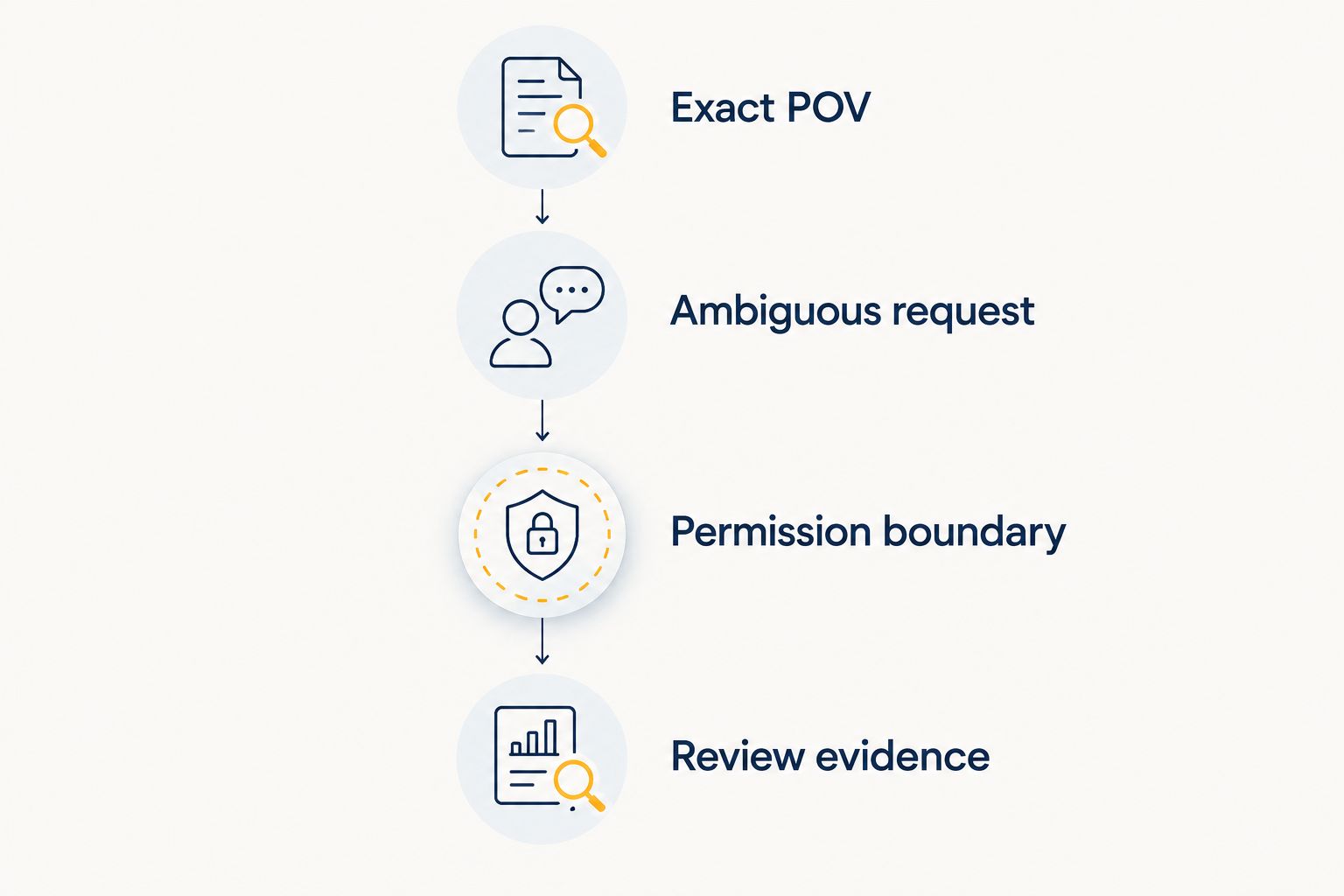
Manual today versus an accepted assistant workflow
The objective is not to remove review. It is to define which interaction changes and which control remains in place.
| Task | Manual today | Target assistant workflow | Control to retain |
|---|---|---|---|
| Retrieve a balance | Select the POV and inspect the result | Submit a precise request through an approved connection | Reconcile the returned POV and value |
| Investigate a difference | Gather relevant extracts and compare them | Request a structured comparison of approved data | Separate observed differences from unsupported causes |
| Request an operation | Use the established application process | Submit a request only through an approved operational tool | Preserve authorization and execution review |
| Draft commentary | Write from reviewed consolidation data | Generate a draft from identified source material | Finance reviews the explanation before use |
Treat the assistant column as an acceptance target. Whether a particular implementation satisfies it must be established through the evaluation, not inferred from the presence of a chat interface.
How the options were ranked
The order follows the criteria above: FCCS connection first, implementation ownership second, and the distinction between live access and extract analysis throughout. It is a use-case ranking, not a measured performance benchmark.
For 2026 procurement, require evidence against your own application before accepting claims about accuracy, supported operations, or deployment fit. The same rule applies to a supplied connector and a custom build.
Which Oracle FCCS assistant should you choose?
Start with EPM Copilot when you want plain-language Oracle FCCS access through an MCP connection. Evaluate Claude with a custom MCP server when owning the integration is a requirement, not simply an available engineering option.
Choose a file-based workflow when your actual requirement is commentary on an approved extract. Do not commission an operational integration for a task that ends with reviewing a fixed report.
The deciding question is straightforward: does your team need the assistant to reach FCCS, or only to explain data already taken from it?
FAQ
What are the best AI tools for Oracle FCCS consolidation in 2026?
EPM Copilot is the first option to evaluate for plain-language FCCS access through MCP. Claude with a custom MCP server suits engineering-owned integration, while a file-based assistant workflow suits commentary on approved extracts.
Can Claude connect directly to my Oracle FCCS application?
Claude needs an integration to access your FCCS application. An MCP server can provide that connection; a conversational request alone does not establish application access.
Is an MCP connection better than uploading an FCCS export?
An MCP connection fits application-access requirements, while an uploaded export fits analysis of a fixed dataset. Choose according to whether you need fresh application interaction or commentary on approved data.
Can an assistant run FCCS consolidation operations?
Operational use requires an integration that exposes the specific permitted action. Confirm the supported operation, user permissions, execution controls, and result evidence before approving it.
What should an FCCS assistant return with a balance?
An FCCS assistant should return enough dimensional and application context to reconcile the balance. Define the required POV members and source context in your acceptance criteria.
Should finance or IT own the FCCS assistant?
Finance should own the business acceptance criteria, and IT should own the approved integration and access design. Assign maintenance and incident responsibilities explicitly rather than leaving ownership with the pilot team.
What is the safest starting scope for an FCCS assistant pilot?
Start with read-only requests against predefined POVs and known results. Test ambiguity and permission boundaries before considering operational tools.
One last thing
A correct balance with the wrong POV is still a failed answer. Include a deliberately ambiguous request in your evaluation and require the assistant to stop for clarification. That test reveals whether the workflow respects consolidation context instead of merely producing convincing prose.