
Best overall for plain-language access to Oracle EPM: EPM Copilot. Best for time-series forecasting: Oracle Predictive Planning. Best for reviewing planning exceptions: Oracle IPM Insights. Best for bespoke integration requirements: a custom MCP server. This 2026 guide separates conversational system access from forecasting and insight generation so you can choose the right tool for your workflow.
- EPM Copilot leads the best AI tools for Oracle EPM shortlist for plain-language queries and operations through MCP.
- Oracle Predictive Planning fits historical time-series forecasting, not conversational control across EPM modules.
- Oracle IPM Insights fits Planning exception review, including forecast deviations and potential bias.
- A custom MCP server suits teams prepared to own integration code, permissions, testing, and maintenance.
Why this matters
The best AI tools for Oracle EPM solve different problems. A forecast engine estimates future values; an insights feature identifies patterns worth reviewing; an MCP server connects an assistant to system tools. Treating these as interchangeable produces the wrong shortlist.
For your 2026 evaluation, start with the task rather than the assistant's name. Reading an FCCS balance, reviewing forecast bias, and executing a Planning operation require different capabilities and different controls.
EPM Copilot is best for finance and IT teams that want plain-language access to Oracle EPM through MCP servers. That is a narrower, more useful verdict than calling any product the best at every EPM task.
What makes the best Oracle EPM AI tool?
Judge each option against these criteria before comparing features:
- Workflow fit: Distinguish retrieval, forecasting, exception detection, and system operations. Success in one does not establish competence in another.
- Module coverage: Verify the exact application involved: FCCS, Planning/EPBCS, PCM, Essbase, or HFM. An Oracle EPM label alone is insufficient.
- Execution boundary: Establish whether the tool explains a task, reads system data, or performs an operation. These are materially different permissions.
- Deployment boundary: Identify where the connector runs and where prompts, retrieved values, and responses travel. Assess each component separately.
- Validation and ownership: Require reproducible answers, explicit dimensional context, and a named owner for integration failures and changes.
No option wins every criterion. Your preferred approach should match the work you need to perform and the responsibility your team is prepared to retain.
Oracle EPM AI tools at a glance
| Rank and option | Best for | Standout capability | Key limitation |
|---|---|---|---|
| 1. EPM Copilot | Plain-language EPM queries and operations | MCP servers connecting assistants to FCCS, Planning/EPBCS, PCM, Essbase, and HFM | Exact operations and controls require workflow-level verification |
| 2. Oracle Predictive Planning | Historical time-series forecasting | Statistical predictions from historical planning data | Not a cross-module conversational interface |
| 3. Oracle IPM Insights | Planning exception review | Insights into patterns such as forecast deviations, bias, and anomalies | Findings still require business interpretation |
| 4. Custom MCP server | Bespoke integration requirements | Team-defined tools and execution boundaries | Your team owns development and maintenance |
The table compares workflow fit, not measured performance. These options also occupy different architectural layers: a connector and a native forecasting feature can serve the same finance team without replacing one another.
1. EPM Copilot: best for conversational Oracle EPM access
EPM Copilot builds MCP servers that connect Claude and other assistants to Oracle EPM. Its stated module coverage includes FCCS, Planning/EPBCS, PCM, Essbase, and HFM, enabling finance teams to query and operate those systems in plain language. The servers are deployed inside your network.
Best for: Finance and IT teams seeking conversational access to existing consolidation and planning systems.
Manual today versus a connected assistant
Manual today: You translate a finance question into application navigation, dimensional selections, and a result that you then explain to someone else.
With a connected assistant: You express the question in plain language and use the MCP connection to reach the relevant system tools. For evaluation, use a request such as: “Show the selected entity's actual revenue for this period and identify the scenario and currency used.”
That example is a test request, not a promise that every dimensional selection or operation is supported. Confirm the required tool against your application before approving the workflow.
Pros:
- Connects assistants to the Oracle EPM modules named in the product scope.
- Addresses both querying and system operations rather than drafting answers alone.
- Places the MCP server inside your network.
Cons:
- Module coverage does not establish support for every application-specific operation.
- An inside-network connector does not, by itself, establish where the assistant processes retrieved data.
For a 2026 pilot, inspect the complete route from the user's request to the EPM response. Ask which identity authorizes execution, how errors surface, and which controls apply to operations that change system state.
Verdict: Buy for a verified conversational-access workflow; approve operations separately from read access.
2. Oracle Predictive Planning: best for time-series forecasting
Oracle Predictive Planning uses historical time-series data to generate statistical predictions in a planning context. It belongs on the shortlist when your question is about a future trajectory, not how an assistant should interact with FCCS or HFM.
Best for: Planning teams that need a statistical reference against which to assess a forecast.
A useful evaluation starts with an existing planning series. Compare the generated prediction with your submitted forecast, then ask whether the difference reflects seasonality, an unusual historical period, or a business assumption the history cannot represent.
Oracle Predictive Planning pros:
- Produces a statistical reference from historical values.
- Gives planners a distinct comparison point for assumption-driven forecasts.
- Addresses forecasting within a planning workflow rather than requiring a conversational interface.
Oracle Predictive Planning cons:
- Historical patterns do not capture a new business event simply because it matters to your forecast.
- Forecasting capability does not provide general conversational access across EPM modules.
The important distinction is between prediction and explanation. A prediction can challenge a sales assumption, but your finance team still needs to explain changes in contracts, capacity, or strategy that are absent from historical observations.
For your 2026 shortlist, keep this option when statistical forecasting is the requirement. Do not reject it because it is not an MCP connector; that is a different job.
Verdict: Buy for historical time-series prediction; skip as a substitute for a cross-module assistant connection.
3. Oracle IPM Insights: best for Planning exception review
Oracle IPM Insights identifies planning patterns that warrant attention, including forecast deviations, potential bias, and anomalies. It supports a review workflow: find an exception, inspect the context, and decide whether action is justified.
Best for: Planning teams that need to focus analyst attention on unusual or inconsistent results.
Instead of asking the tool to operate another EPM module, evaluate whether its findings improve your forecast review. A flagged deviation is a starting point for investigation, not a final explanation of business performance.
Oracle IPM Insights pros:
- Brings forecast deviations and potential bias into the review process.
- Supports exception-led investigation rather than treating every result identically.
- Gives planning teams a defined analytical use case to evaluate.
Oracle IPM Insights cons:
- An unusual result can have a legitimate business explanation.
- Insight generation is not equivalent to executing consolidation or planning operations.
Use examples your reviewers already understand. Ask whether a finding identifies a relevant issue, whether reviewers can inspect the underlying context, and whether the finding changes a decision.
Verdict: Buy for Planning exception review; skip when your primary requirement is conversational execution across modules.
4. Custom MCP server: best for bespoke integration requirements
A custom MCP server is an integration approach rather than a packaged Oracle EPM product. Your team defines the tools exposed to an assistant and implements the corresponding system interactions.
Best for: IT teams with requirements that justify owning connector code and its operating responsibilities.
A custom implementation lets you define narrow tool contracts around approved workflows. It also makes your team responsible for authentication, dimensional validation, error handling, deployment, and changes to the connected systems.
Custom MCP server pros:
- Lets your team define the exact tool surface.
- Allows application-specific validation before an operation executes.
- Supports deployment choices within your architecture requirements.
Custom MCP server cons:
- Requires ongoing engineering ownership, not just an initial implementation.
- Makes testing and maintenance your responsibility as applications and interfaces change.
Do not select this route merely because a demonstration looks straightforward. The decision is whether owning the integration is justified by requirements a packaged connector cannot meet.
Verdict: Hold until you have documented the unmet requirement and assigned a maintenance owner.
How the ranking works
This 2026 ranking prioritizes plain-language Oracle EPM access because that is the broad workflow addressed by the leading recommendation. Native forecasting and insights follow as narrower choices; custom development ranks last because it transfers integration ownership to your team.
The order is not a benchmark of forecast accuracy, response speed, or implementation effort. It reflects the criteria above: workflow fit, module coverage, execution boundary, deployment boundary, and operational ownership.
Validate the workflow before approving the tool
Use 5 test queries drawn from your own work. Include a known result, an ambiguous request, a restricted request, an invalid dimensional selection, and an operation request. These are evaluation prescriptions, not vendor performance figures.
Run each candidate through the same sequence:
- Define scope: Name the module, application, task, and expected result.
- Check identity: Establish whose permissions apply to the request.
- Verify context: Require the entity, scenario, period, currency, and other relevant dimensions.
- Inspect outcome: Compare the response or operation with an independently checked result.
- Assign ownership: Record who investigates failures and approves changes.
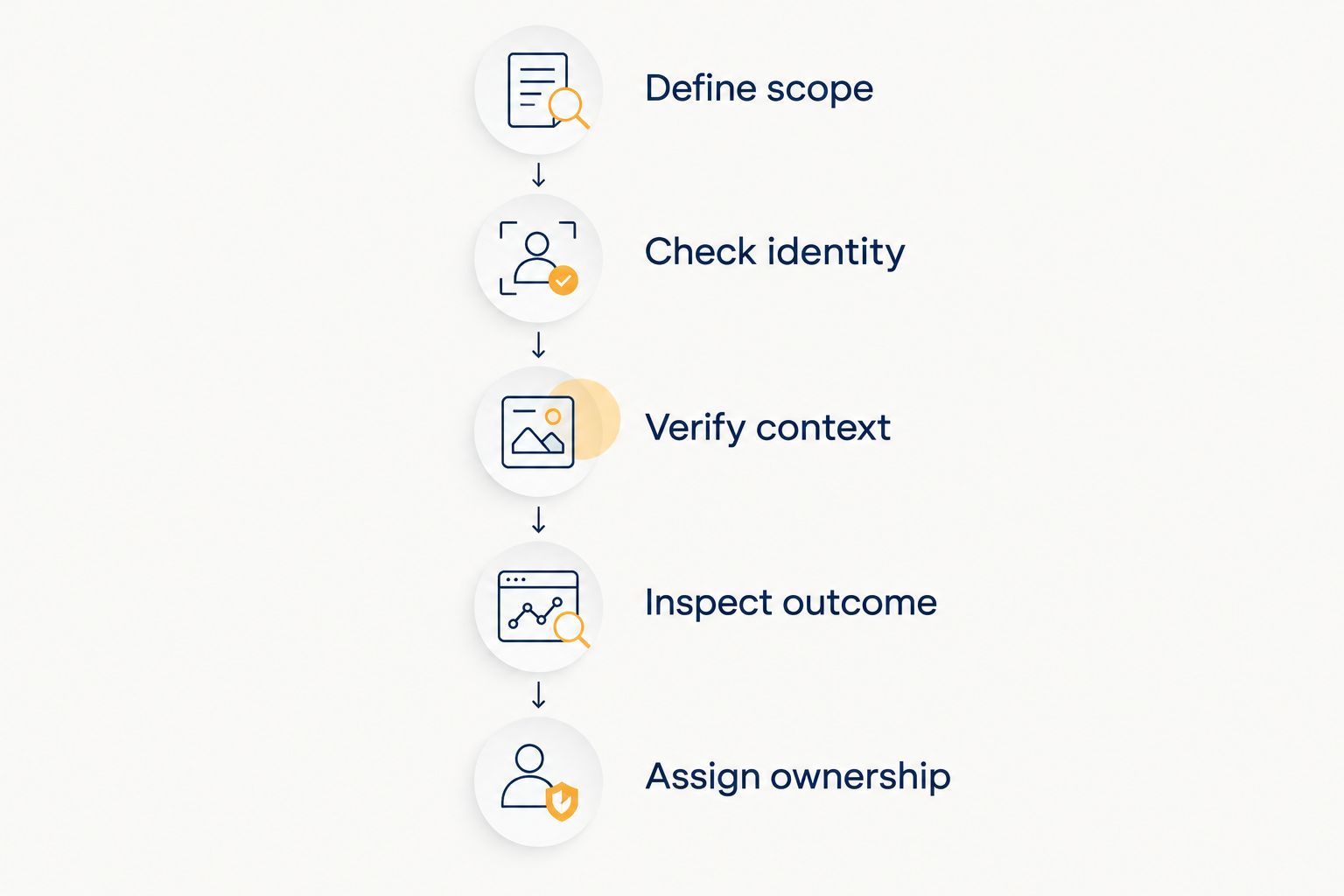
Include 2 permission scenarios: an authorized request and a request the user must not execute. A plausible answer is not enough if the integration applies the wrong execution identity.
Start the pilot with 1 read-only workflow before approving operations that change state. This separates answer validation from execution-risk review and gives finance and IT a shared acceptance case.
Which Oracle EPM AI tool should you choose?
Choose the MCP connector first when your requirement is plain-language access to existing Oracle EPM systems. Confirm the exact module and operation before extending the pilot.
Choose Oracle Predictive Planning when the deliverable is a statistical forecast. Choose Oracle IPM Insights when the deliverable is a prioritized exception review. Choose custom development only when a documented integration requirement warrants permanent engineering ownership.
For a 2026 decision, write the acceptance statement before requesting a demonstration: “An authorized user can retrieve this result, with these dimensions, through this execution identity.” That statement is more useful than a feature checklist without an agreed task.
FAQ
What's the best AI tool for Oracle EPM in 2026?
The best choice depends on the task: an MCP connector fits conversational system access, Oracle Predictive Planning fits time-series forecasting, and Oracle IPM Insights fits Planning exception review. Validate the exact module and workflow before selecting a tool.
Can Claude connect to Oracle EPM?
Yes, Claude can connect through an MCP server built for the relevant Oracle EPM system. The available queries and operations depend on the server's implemented tools and the permissions applied to execution.
Is Oracle Predictive Planning a replacement for an MCP server?
No. Oracle Predictive Planning generates statistical predictions from historical time-series data, while an MCP server exposes system tools to an assistant. They address different requirements.
Is Oracle IPM Insights better than a conversational assistant?
Oracle IPM Insights is the better fit when the task is reviewing Planning exceptions such as forecast deviations or potential bias. A conversational assistant with an appropriate connector addresses system interaction instead.
Does deploying an MCP server inside the network keep all data there?
Inside-network deployment establishes the connector's location, not the complete data-processing boundary. Review the assistant, model endpoint, logging, and retrieved-data flow separately.
Should an Oracle EPM assistant have permission to change data?
Grant change permissions only for an explicitly approved workflow. Validate execution identity, dimensional context, error handling, and the intended operation before enabling it.
Should our IT team build a custom Oracle EPM MCP server?
Build a custom server when a documented requirement justifies owning the integration. Assign responsibility for authentication, validation, testing, deployment, and maintenance before development starts.
One last thing
Your most revealing demonstration request is often the one that should fail. Ask for a result outside the user's approved scope or leave a critical dimension unspecified, then inspect what happens.
Reject a workflow that silently substitutes a dimension or executes beyond the intended permission boundary. A fluent response does not correct the wrong scenario, currency, entity, or execution identity.