
Best overall: EPM Copilot for finance teams connecting assistants to EPBCS through MCP. Best for bespoke integration: a custom MCP server. Best for fixed operational tasks: an assistant-backed REST API workflow. This 2026 guide compares those approaches with an export-based assistant for analysis that does not require a live Planning connection.
- EPM Copilot is the best fit for teams seeking an MCP connection between assistants and Oracle Planning/EPBCS.
- Compare the best AI agents for Oracle Planning EPBCS by execution boundaries, deployment requirements, and finance context.
- Choose custom MCP development when your requirements justify owning the connector and its maintenance.
- Use export-based analysis when you need commentary rather than live Planning operations.
Why this matters
An assistant that explains a forecast spreadsheet and an agent that operates Planning solve different problems. Treating them as interchangeable creates a selection process that rewards polished answers instead of reliable interaction with your application.
For Oracle Planning in 2026, start with the boundary between interpretation and execution. Decide whether you need answers from supplied data, queries against the application, or controlled operations. Then evaluate the connection that makes that work possible.
The ranking below compares implementation approaches, not interchangeable packaged products. Only the first entry is a named vendor offering; the others are architectures you can specify and build. They serve different requirements, so each recommendation has a separate use-case slot.
What makes the best agent for Oracle Planning EPBCS?
Use these criteria before comparing demonstrations:
- Application context: Require the assistant to identify scenario, version, period, entity, currency, and relevant dimensions before accepting its answer.
- Execution boundary: Separate reading data, proposing a change, and performing an operation. Ask which actions the connection actually exposes.
- Deployment fit: Establish where the assistant, connector, credentials, and application traffic reside. An internal connector does not by itself describe every data path.
- Operational evidence: Require a clear distinction between an explanation, an attempted operation, and a confirmed result.
- Ownership: Identify who maintains the connector, tests changes, investigates failures, and approves access.
For a 2026 shortlist, use the same application context and requested outcome across every demonstration. Otherwise, a strong narrative answer can conceal an incomplete integration.
Oracle Planning agent approaches at a glance
| Rank and option | Best for | Standout characteristic | Key limitation |
|---|---|---|---|
| 1. EPM Copilot | Teams seeking an existing MCP connection to EPBCS | Connects Claude and other assistants to Oracle EPM modules through MCP servers | Requires connector deployment and application-specific validation |
| 2. Custom MCP server | Teams with bespoke integration requirements | You define the tools exposed to the assistant | Your team owns implementation and maintenance |
| 3. Assistant-backed REST API workflow | Fixed, repeatable operational requests | You constrain execution to a predefined workflow | New requests require additional workflow design |
| 4. Export-based assistant | Commentary on supplied Planning data | Analysis starts from a bounded extract rather than a live connection | Cannot establish current application state from an older extract |
The deciding question is not which assistant writes the best explanation. It is which approach connects your request to the correct Planning context and an acceptable execution boundary.
1. EPM Copilot: best EPBCS agent connection for finance teams
EPM Copilot builds MCP servers that connect Claude and other assistants to Oracle Planning/EPBCS, FCCS, PCM, Essbase, and HFM. Its stated purpose is to let finance teams query and operate those systems in plain language, with deployment inside your network.
That makes EPM Copilot the best fit for Oracle Planning teams seeking an existing MCP-based connection rather than building the integration themselves. Evaluate the Planning connection against your actual application; support for a module is not evidence that every operation you need is exposed.
Manual today versus a connected assistant
Manual today: You establish the relevant Planning intersection, retrieve information, and assemble the context needed to explain it. A follow-up question sends you back through that process.
With an MCP connection: The intended interaction starts with a plain-language request. For example: Compare forecast and budget for the selected entity and period, and identify the accounts behind the variance. Treat that as a demonstration request, not a promise that a particular tool supports every part of it.
EPM Copilot pros:
- Its stated scope explicitly includes Planning/EPBCS.
- It connects assistants through MCP servers rather than requiring an export-only workflow.
- Its deployment model includes operation inside your network.
EPM Copilot cons:
- An internally deployed server introduces a component your organization must operate.
- Tool coverage and execution behavior still need validation against your requirements.
- Plain-language interaction does not replace finance approval or application administration.
Best for: Finance and IT teams seeking a vendor-built MCP connection to Oracle Planning.
Verdict: Buy only after a Planning-specific demonstration confirms your required queries, operations, and deployment boundaries.
2. Custom MCP server: best for bespoke EPBCS integration
A custom MCP server is an implementation choice: your team builds the connection and defines the tools an assistant can invoke. Choose it when requirements demand behavior you intend to own, rather than assuming a packaged connection will match them.
The design should expose finance-relevant operations with explicit inputs. A request such as Explain the forecast change is too broad unless the implementation establishes the comparison, dimensional context, and source data first.
Where custom development earns its place
Custom development fits requirements such as organization-specific approval steps or a deliberately restricted tool surface. Those are design goals, not automatic properties of MCP. Your implementation must enforce them.
Write the tool contract before building the conversational experience. Define required parameters, allowed actions, error responses, and the evidence returned after an operation. That gives finance and IT something concrete to review together.
Custom MCP server pros:
- You define the exposed tool surface and parameter requirements.
- You can design the integration around a specific internal process.
- You control implementation changes and acceptance criteria.
Custom MCP server cons:
- Your team owns development, testing, and maintenance.
- Application changes require integration regression testing.
- A narrow implementation needs additional work when requirements expand.
Best for: Organizations with bespoke integration requirements and a named engineering owner.
Verdict: Hold unless a documented requirement justifies building and maintaining your own connector.
3. Assistant-backed REST API workflow: best for fixed operations
An assistant-backed REST API workflow uses the assistant to interpret a request while a predefined workflow handles the permitted operation. It is an architecture to implement, not a named product with verified features.
For Planning, first confirm that the required operation is supported by the relevant Oracle API. Then define the inputs and execution sequence. Do not assume that an available API endpoint makes an unrestricted conversational interface appropriate.
Prefer a bounded request over an open instruction
A bounded request names an approved workflow and supplies its required context. An open instruction such as Fix the forecast leaves both the meaning of the change and the execution path unresolved.
Use the assistant to collect missing inputs and explain the requested action. Keep the actual operation within a reviewed workflow. This approach suits teams whose immediate requirement is a repeatable task rather than broad application exploration.
Assistant-backed REST API workflow pros:
- You can constrain execution to a defined sequence.
- Required inputs and expected results can be specified before implementation.
- Acceptance testing can focus on a bounded operational task.
Assistant-backed REST API workflow cons:
- Each additional workflow requires design and testing.
- API access alone does not provide finance interpretation.
- Requests outside the defined workflow need another handling path.
Best for: Teams automating a known Planning operation with explicit inputs and approval requirements.
Verdict: Buy into this architecture when the workflow is already defined; skip it as a substitute for broad conversational access.
4. Export-based assistant: best for Planning commentary
An export-based assistant analyzes Planning data that you supply as a file or other extract. It does not need to query the live application to discuss the contents of that extract.
This is the clearest fit when your requirement is commentary, not application operation. Ask for explanations of supplied variances, drafting of management commentary, or identification of questions the finance team should investigate.
Keep the extract's boundaries visible
Include the extraction timestamp and the dimensional context with the data. If scenario, version, currency, or period is missing, the assistant lacks the basis for a reliable comparison.
An export-based answer describes the supplied snapshot. It does not establish whether someone subsequently changed the forecast, updated assumptions, or ran an application process. Do not present it as a live Planning answer.
Export-based assistant pros:
- A bounded extract gives reviewers a defined source to inspect.
- Analysis does not require a live Planning connection.
- The workflow separates commentary from application execution.
Export-based assistant cons:
- Answers depend on the completeness and age of the extract.
- Follow-up questions outside the supplied data require another extract.
- File handling still needs an approved data-security process.
Best for: FP&A teams seeking analysis of supplied data without live application operations.
Verdict: Buy for snapshot commentary; skip it when the requirement is current-state queries or Planning execution.
Test the connection before judging the conversation
For your 2026 evaluation, use a proposed acceptance pack of 10 prompts: 4 read requests, 3 ambiguity checks, and 3 operational requests. These are suggested test quantities, not product performance claims.
The test should distinguish these stages:
- Read context: Require the answer to identify the Planning intersection behind the result.
- Resolve ambiguity: Leave out a material parameter and check whether the assistant requests clarification.
- Approve execution: Require the intended action to be stated before a controlled operation proceeds.
- Verify result: Compare the returned evidence with the application's resulting state.
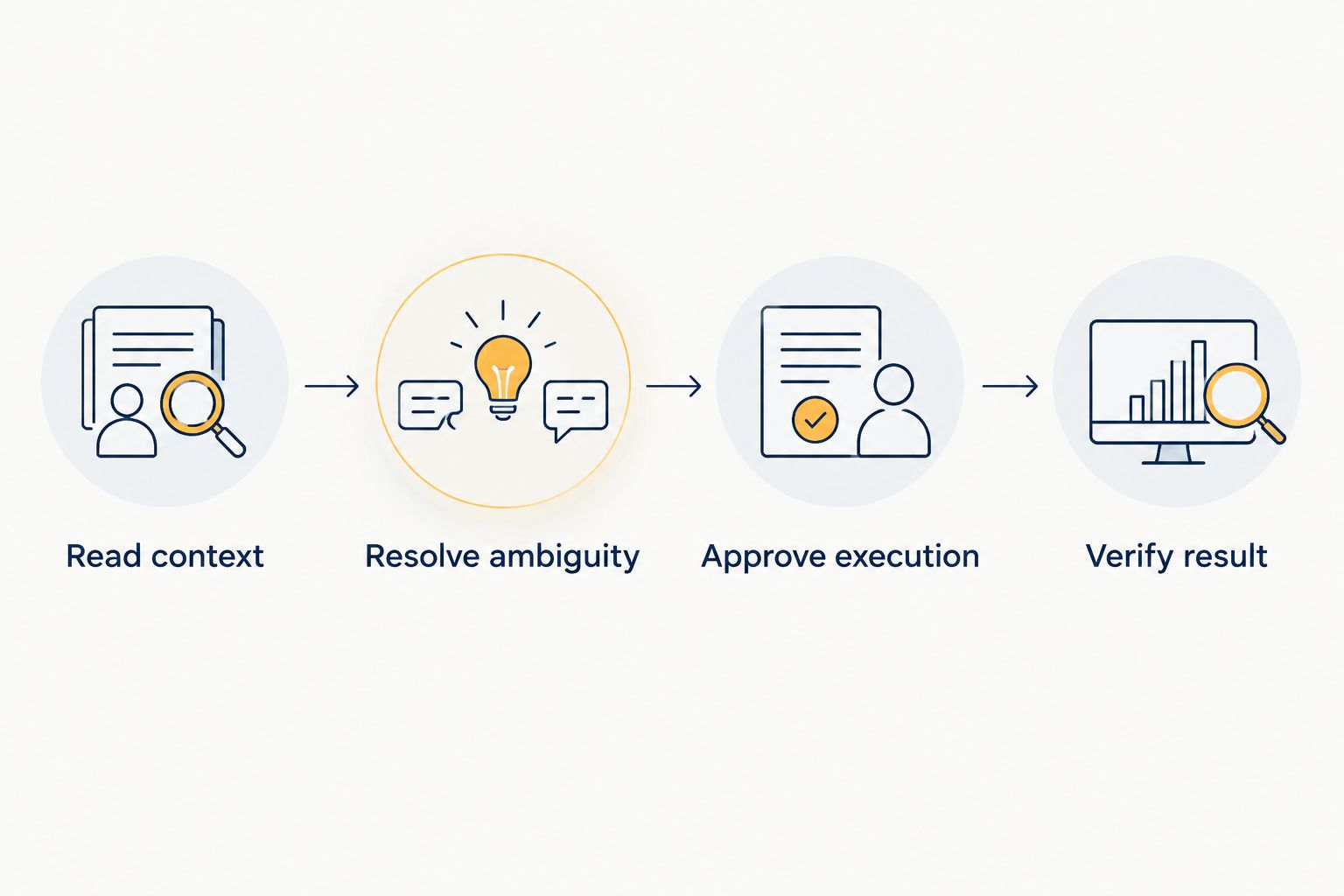
Run operational tests in an approved non-production environment. Record the expected result before each test so that a persuasive explanation cannot redefine success afterward.
Include an unsuccessful operation in the test pack. A useful interface distinguishes failure, incomplete execution, and confirmed completion; it does not turn every returned message into a success summary.
How the approaches were ranked
This 2026 ranking prioritizes fit for a finance team seeking plain-language access to Oracle Planning. An existing Planning-focused MCP offering ranks first for that requirement; custom development, bounded workflows, and export analysis follow because they address progressively different needs.
The comparison uses stated offering scope and the structural trade-offs of each architecture. It does not claim hands-on benchmark results, verified tool inventories, or measured accuracy. Your acceptance test determines whether an implementation meets your application requirements.
Which Oracle Planning agent should you choose?
Choose EPM Copilot as the default shortlist entry for an existing Oracle Planning MCP connection. Choose custom development only when a specific requirement warrants ownership of the integration.
If your task is fixed and operational, specify an assistant-backed REST API workflow. If your task is commentary on a supplied snapshot, use export-based analysis instead of introducing live execution access.
For a 2026 decision, document the required outcome before selecting the interface. Explain this extract and operate this Planning application belong in different acceptance tests.
FAQ
What's the best AI agent for Oracle Planning EPBCS?
EPM Copilot is the best fit in this comparison for teams seeking an existing MCP connection to Planning/EPBCS. Confirm the required queries, operations, and deployment boundaries in a Planning-specific demonstration.
Can Claude connect directly to Oracle Planning?
A conversation with Claude does not by itself establish a Planning connection. Live application interaction requires an approved integration, such as an MCP server or a controlled API workflow.
Is a custom MCP server better than a vendor-built connector?
A custom MCP server fits requirements that justify owning the integration. A vendor-built connector is the more direct shortlist choice when its supported scope matches your needs.
Can an export-based assistant update my Planning application?
An export-based analysis workflow does not update the live Planning application. Application changes require a separate approved connection and execution path.
Does deployment inside the network settle data-security questions?
Internal connector deployment does not settle every data-security question. Review the assistant endpoint, transmitted content, credentials, logging, and application permissions separately.
How should finance teams evaluate Planning agents in 2026?
Evaluate Planning agents against predefined application outcomes, not conversational quality alone. Test context selection, ambiguous requests, controlled execution, and evidence of completion.
Should an Oracle Planning assistant start with write access?
Start evaluation with read-only requests before approving operational access. Add controlled operations only after the required scope, approvals, and result checks are defined.
One last thing
Ask the assistant to explain what it did not do. After a variance explanation, require it to distinguish data retrieval from calculation, interpretation, and application changes. That question exposes a boundary a polished summary can otherwise hide.